Drumroll Please … The Next Generation of Facebook Marketing is Here!

Posted in Social Media Marketing on January 31st, 2012 by admin

source: http://www.bookbuzzr.com/blog/book-marketing/drumroll-please-the-next-generation-of-facebook-marketing-is-here/

written by: Vikram Narayan

The problem with today’s Facebook fan pages
So you’re an author with a Facebook fan page. You’ve got book trailers, polls, quizzes, photo and writing contests running on your page. You’ve even got a few hundred “Facebook Likes” for your page. And yet your book sales are not going up. You then compare yourself to popular authors with tens of thousands of Fans on their Facebook fan pages. And you wonder what they are doing that you’re not doing.

Here’s what’s happening.

If you are a popular mainstream author, the people becoming fans of your page are people who already read your books or have heard enough about you that they are likely to soon become readers.

If you are not yet a literary superstar, then the people who are “Liking” your page are doing so because of some other inducement that you may be providing (“get entered into a prize drawing if you Like my page”). They are unlikely to think about you or notice your book even if they “Like” your Facebook fan page. And they are unlikely to return to your Facebook page or tell their friends about it.

Thus, while a Facebook fan page (and associated bells and whistles such as the BookBuzzr Facebook Fan Page Widget) is a necessary condition for entry into the book marketing game, it is not sufficient.

So how do you actually find some readers for your book?

John Locke’s Principle of Transfer of Loyalty
A few months ago, best-selling author – John Locke – wrote a book – “How I Sold a Million Books”. In this book John comes up with the concept of “Transfer of Loyalty”. The idea is simple and fairly well-known. It is best illustrated by an example.

Let us say that you’ve written a vampire romance book and your target audience is the set of people who liked the Twilight movie series. You write a blog post on the Twilight movie series and promote the blog post on Twitter to Twilight movie fans. Some of these folks will read your blog post and get exposed to your book. Some of your blog post readers may now “transfer their loyalty” to give your book a try.

While this is a fantastic, proven concept, we at BookBuzzr, believe that the principle can be extended to find readers on Facebook.

Characteristics of Facebook users
Some of the characteristics of Facebook users are:
1. They don’t like reading lengthy blog posts while on Facebook.
2. They like playing trivia games
3. They like sharing fun stuff with their friends
4. They are usually thinking WIIFM (What’s in it for me?)

Announcing QuizBuzzr – a revolution in book marketing on Facebook

Melding John Locke’s loyalty transfer principle with our insight about Facebook users, we’ve come up with QuizBuzzr.

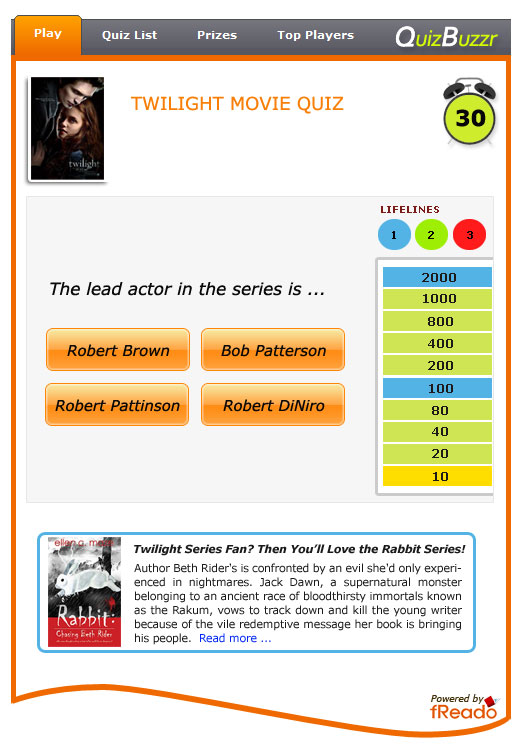
QuizBuzzr is a quiz that you, the author, create. There are ten questions in each quiz. The quiz would ideally appeal to your target audience. For example, if you think that fans of the Oprah Winfrey show would enjoy your book, you would create a quiz featuring 10 questions about Oprah Winfrey.

QuizBuzzr also features “Lifelines”. Clicking on these will offer you clues to the correct answer with one twist – some of them require you to share the game with your Facebook friends.

QuizBuzzr is also made interesting by the fact that at each point during the game, you can “Walk Away” from the game thereby saving the points earned till that point or risk it all by trying to answer the next question.

And we’ve built in several ‘viral hooks’ which cause users to share information about the specific quiz and about your book with their Facebook friends.

And winning points in the game allows users to use those points on Freado.com where they can win real prizes including Kindles and best-selling books.

Why is this useful for you?

To summarize, this technology is particularly useful because:

1. You can create several quizzes that are likely to appeal to your readers.
2. It shows up your book at strategic points in the game alongside the questions.
3. As described earlier, it appeals to the average Facebook user.
4. Because of the in-built viral hooks at various points in the game, your book will be surely be marketed.

How can you use QuizBuzzr to market your book on Facebook?
QuizBuzzr will soon be released as a test beta product. It comes bundled with a BookBuzzr Author Pro subscription. To use it to market your book, simply sign-up for a BookBuzzr Author Pro account.

Related Posts
A Writer’s Guide to Social Networking
The 7 Deadly Sins of Online Networking

Bookmark and Share:
TwitterStumbleUponFacebookMySpaceDiggdel.icio.usLinkedInGoogle BookmarksReddit Yahoo Buzz

Connect to us via our other social media buttons. Just pick your click!

Tags: ,

Three Roadblocks of Indie Authors

Posted in Book Marketing on September 6th, 2011 by admin

Source: http://www.articlesbase.com/self-publishing-articles/three-roadblocks-of-indie-authors-5139533.html

Independent authors are in a unique situation.  For the first time, writers and publishers are not dependent on each other.  Indie authors can publish books without a mainstream publisher or an agent.  But in doing so, indie writers have unique roadblocks that can hinder them, that successful authors don’t necessarily have.

Are Indie Books Good?

One of the stigmas that independent writers have to overcome is ‘indie books aren’t good’.  Let’s face it, there are a lot of bad books out there, where the indie author did not take the time to write a book in which the plot is good, the book is edited well, and free of grammatical errors.  So independent writers have to work around this.  The best thing an indie writer can do is to pen a phenomenal book and get it edited by both a story editor and a language editor.  Make sure your indie books are great.

Author Websites

Along with writing a great book, independent writers need to make sure they are marketing their books, and one key way is to have a great author website.  I have seen way to many authors that use a blog for a website.  There is nothing wrong with this, as long as the blog looks like a website, and it is set up well.  The roadblock of author websites is that indie authors typically don’t have, or don’t want, to spend money if they don’t have to.  But this is a critical area where you should spend to get the best.

Not Understanding Marketing

Indie writers need to understand that writing a novel and marketing a novel are two different things.  So many authors have websites, blogs, and Facebook fan pages that have poor copy-writing.  As an author, you have to understand how marketing is a different skill, one that takes
time to learn.  If you do not have the time to learn this, you should consider hiring this out.

Final Thoughts

In order to sell books, not only do you need a great website,you need to have a Facebook fan page, because Facebook has over 700 million followers that can become your fans.  But your Facebook fan page needs to be a great page that focuses on marketing.  If you would like to receive more tips on how to set up a Facebook fan page, AND how to market yourbooks, visit  here for more tips.  Remember, you CAN learn how to market your books!

Renee PawlishAbout the Author:
If you enjoyed this article and would like several more FREE tips, go to fanpagemagic for more valuable information.

Renee Pawlish is the author of Nephilim Genesis of Evil, and The Reed Ferguson mystery series.  She
also consults with authors and other entertainers, helping them learn how to effectively market their books or music.


Author Websites

Along with writing a great book, independent writers need to make sure they are marketing their books, and one key way is to have a great author website.  I have seen way to many authors that use a blog for a website.  There is nothing wrong with this, as long as the blog looks like a website, and it is set up well.  The roadblock of author websites is that indie authors typically don’t have, or don’t want, to spend money if they don’t have to.  But this is a critical area where you should spend to get the best.

Not Understanding Marketing

Indie writers need to understand that writing a novel and marketing a novel are two different things.  So many authors have websites, blogs, and Facebook fan pages that have poor copy-writing.  As an author, you have to understand how marketing is a different skill, one that takes
time to learn.  If you do not have the time to learn this, you should consider hiring this out.

Final Thoughts

In order to sell books, not only do you need a great website,you need to have a Facebook fan page, because Facebook has over 700 million followers that can become your fans.  But your Facebook fan page needs to be a great page that focuses on marketing.  If you would like to receive more tips on how to set up a Facebook fan page, AND how to market yourbooks, visit  here for more tips.  Remember, you CAN learn how to market your books!

Related Posts
Clone Yourself: Marketing Tips That Help You Be In Two Places At The Same Time
How Authors Can Use Their Books as a Basis for an Internet Business

Bookmark and Share:
TwitterStumbleUponFacebookMySpaceDiggdel.icio.usLinkedInGoogle BookmarksReddit Yahoo Buzz

Connect to us via our other social media buttons. Just pick your click!

Tags: , , ,

Misconceptions and the Truth About Book Marketing on Twitter

Posted in Book Marketing on August 15th, 2011 by admin

Source: http://www.millermosaicllc.com/book-marketing-on-twitter/

Here’s an email I got from a book author:

I’m going to look into Twitter but I don’t have a Blackberry or anything mobile I can portably communicate with, other than my laptop — it seems like a good way to broadcast events, readings or online chats or something, but right now I have nothing like that to announce. It seems like it would be more of a constant annoyance than something I’d like, but I could be wrong.

There are several misconceptions in the above email, and I’d like to explain the errors first, then follow with the benefits for book authors being on Twitter.

Correcting the above misconceptions:

1. I do my tweeting from my computer.

You do NOT need a Blackberry or any mobile phone to participate in Twitter, although there are Twitter applications for mobile phones. In fact, Twitter is so popular that there are tons of third-party applications, a couple of which I do use.

2. A book author should NOT get onto Twitter with the plan to “broadcast events.”

In fact, if you continually tweet about your book signings, etc., you probably will discourage people from following you. (Follow is the term on Twitter as opposed to friend on Facebook.)

3. If used correctly, Twitter is NOT a “constant annoyance.”

In fact, it can be quite an enjoyable daily experience and a tremendous learning opportunity.

Presenting the truth about Twitter for book authors:

Twitter provides book authors with several benefits. First, though, let’s go through a few basic points about Twitter. And I mean only a few, because I could go on for pages on just the most important Twitter info.

Step 1
Decide on how you want to present yourself on Twitter.

You can have, for example, as a username (seen next to your photo each time you tweet) your real name, your book title or your series title.

Because Twitter is a very effective branding tool when used correctly, this is an important decision. If you decide to go with a book title or series title, be sure to also get a Twitter account with your real name to protect your identity. You can do this by using a different email address to sign up for a second email account. Then you tweet only with the first username.

Step 2
Twitter has very few options to make decisions about, as opposed to Facebook’s complicated menus of choices regarding privacy, etc.

On the tool bar of Twitter click SETTINGS. Then on the account page is where you put your real name in the first box. (Your username shows up automatically when you tweet.)

You only get to put in one URL, so if you have more than one URL, choose the URL that goes with the book or series you are “promoting” on Twitter.

The one-line bio is only 160 characters, so again you have to strategize about what you want to say about you as an author and about your book(s). You might want to check out other authors’ Twitter bios to get ideas of how you might want to write yours.

And most important, upload a photo immediately before you start following anyone. Many people, me included, are reluctant to follow anyone who doesn’t have a photo, doesn’t include his/her real name, and doesn’t have any bio info.

Also, do a couple of interesting tweets before you start following people, so that when people look at your page to see if they want to follow you back, they get a decent “picture” of who you are.

You could talk about your book in one of those tweets. In another tweet, though, I recommend you share a link to book marketing info that isn’t your own or share a link to someone else’s info on the subject of your book. Sharing info of others is a very valuable strategy on Twitter.

Step 3
You’re brand new to Twitter. Who do you start following and who do you hope starts following you?

First, if you follow someone, that person will probably check you out and possibly start following you. So that’s one way of getting followers.

Another way is to ask for followers. You can put in a blog post or anywhere else your Twitter URL – www.Twitter.com/username – and ask people to follow you.

But what about who you should follow? Decide on the kinds of people you want to follow depending on your book and the conversation topics you might want to follow.

Then go to the search button at the bottom of your Twitter home page. Put keywords in the box to find conversations about these words. Then check out the people whose tweets come up.

Step 4
Of the many third-party applications for Twitter, if you have a blog check out Twitterfeed.com, which you can use to automatically bring in the post feeds from your blogs.

There are some people who advocate NOT doing this and instead tweeting about your most recent blog post with the link to the post. Others, especially people with more than one blog, prefer to have the feeds done automatically.

Okay, now we’ve covered some of the most important basics of Twitter, although remember my earlier disclaimer – I could go on for pages and pages about the basics of Twitter.

Book marketing “campaigns”:

Twitter is, in my opinion, the absolute best social networking platform at the moment for establishing online relationships (and people buy books online), including the 140-character limit plus everything is public (no having to open emails to discover they go on and on). By public I mean you have a stream of tweets of the people you have chosen to follow.

The second is that there’s a general “rule” for people who know how to use Twitter effectively: It’s not only about you – the best Twitter users share valuable information (connected to who they are) with their followers. This opportunity to learn is what I especially appreciate on Twitter.

For example, by following other book authors, book agents, book editors, publishers, I have an automatic assistant who screens for me the best book marketing/book publishing info out there on a daily basis. Yes, I have blog feeds that go into my Google reader, but I never look at the reader because I have no time.

Twitter is my personal reader. I simply skim my Twitter stream to see if any of the book people I’m following have recommended a blog post. (The post can be theirs or someone else’s.) And I look at the topic covered in the tweet. If it looks as if I can learn from that post, I’ll quickly click through and see if I think the post is worth my limited time to read it.

If you want to be known as someone worth following in the book world, it behooves you to share worthwhile links with people. Here’s one that I’ve been sharing recently. It’s an ebook by @BookMarketer on how to sell books to libraries — http://www.sellingtolibraries.com/ I bought the ebook, read it, and was very impressed. So I tweeted about the report and included the link.

Tweeting about your book:

Yes, you can tweet about your book when it’s appropriate. And you can do such marketing strategies as what I did with my MRS. LIEUTENANT: A SHARON GOLD NOVEL. I offered a signed copy for each of the top five donors to a fundraising campaign for deployed U.S. soldiers. This offer got extensive publicity for the book without my “broadcasting” promo news about it.

___


Phyllis Zimbler Miller is a National Internet Business Examiner at http://budurl.com/internetbusiness as well as a book author, and her company http://www.MillerMosaicLLC.com provides internet marketing information with easy-to-implement solutions to promote your brand, book or business.

Related Posts
How Authors Can Use Their Books as a Basis for an Internet Business
The Importance Of Social Networking To Authors And Professionals

Bookmark and Share:
TwitterStumbleUponFacebookMySpaceDiggdel.icio.usLinkedInGoogle BookmarksReddit Yahoo Buzz

Connect to us via our other social media buttons. Just pick your click!

Tags: ,

Readers Who “Like” You, or Readers Who “Friend” You — Which Is Better?

Posted in Social Media Marketing on January 18th, 2011 by admin

source: http://www.bookbuzzr.com/blog/book-marketing/readers-who-like-you-or-readers-who-friend-you-which-is-better/

Guest Expert: Laurel Marshfield

This year, Facebook topped 550 million members. If it were a country, Facebook would be the third largest in the world (ahead of the United States, in fourth place with a mere 309 million).

Impressive numbers, but why should that interest authors – interest you as an author? Here’s why.

If only a tenth of a relatively small percentage of all “Facebookians” became your loyal readers, you could easily attain the Ultimate Author Dream: Writing the books you most want to, while netting the royalties associated with authors who are mega famous.

Maybe you’d like to know, right about now, what the basic guidelines for attracting readers on the biggest social networking site in the world are?

You Have to Play to Play

If you don’t already have one, set up a “profile page” – a basic Facebook account. Simply go to www.facebook.com and fill in the requested information (realize that you must christen your profile page with your real name – a Facebook rule; if you need to differentiate your page from all the other Jane or John Smiths on the site, use a middle name or middle initial).

Once you have a profile account, you’ve earned the right to create a “fan page.” That’s where you’ll stage the serious book promotion designed to attract your new readers. (Quick aside: you can create as many fan pages as you want, but you only get one profile page — in the same way that you only get one name.) Go tohttp://www.facebook.com/pages/create.php to set up your fan page, or pages.

Profile Page, Fan Page, What’s the Difference?

Your profile page is for friends — for fun. But only 5,000 people can “Friend” you, or join your page and get your status updates in their Facebook feed. Your fanpage is for fans, readers, clients — for business. An unlimited number of people can “Like” you, with the same result as above. There are, however, some areas of overlap, and your profile page can and will draw potential readers, too.

To see how the differences play out, let’s explore the Facebook world of author and attraction coach, Eva Gregory. Esteemed in her field, she’s written two books, one of them with Jack Canfield of Chicken Soup for the Soul fame. (Another quick aside: the Facebook pages of famous authors aren’t particularly helpful, as they’re either maintained by their publishers – see Dan Brown, or they only contain a Wikipedia profile – see Jodi Picoult. But Gregory’s pages are instructive.) Here’s her profile page: http://www.facebook.com/evagregory ; and here’s her fan page:http://www.facebook.com/evagregoryfan (notice how she finds a way to use her name for both pages while making the difference clear; yet she’s still playing by Facebook’s rules).

If you go to the Info tab on Gregory’s Profile page, you’ll see a multi-paragraph description of her background, her service offerings, her books and programs, and her several businesses. You would not be amiss to wonder what all that has to do with “fun” and “friends.” But this is where that aforementioned overlap between the two pages resides. (Also note that, like everyone else with a Facebook profile page, Gregory’s nearly 5,000 “Friends” are most likely not friends in the usual sense, but in the social networking sense.)

Now, if you click over to Gregory’s fan page, you’ll see an immediate difference in both design and approach. A first-time visitor will enter through a Welcome page, and will be greeted with a pitch video, an ezine signup form, and a big, bold logo. You know right away that this page is about business – a friendly sort of business – but still, those profile page lists of interests and favorite movies are gone. In their place, you get a guided tour of Gregory’s many, many offerings.

Why Bother with Facebook When You’ve Got a Site?

It may seem odd that Gregory has established her presence so solidly on Facebook when — as you may remember from the Info tab of her profile page — she has three websites. Well, here’s why it’s not redundant, why it’s actually new territory. Facebook is where the people are. More people, in fact, than the entire population of the United States. Optimistically speaking, up to half of them could be readers. Being able to access that many potential book buyers in one place offers a huge advantage to any author — one that has never been available before. How can you make the most of it?

Finding Readers on Facebook

Scroll up to the top of any Facebook screen and you’ll see a Search box. To find potential readers, type in keywords like “Self-Help Author,” “Mystery Author,” and “YA Author” — based on your book genre or niche. Then try the plural and singular variations of other author- and book-related words. The results may appear erratic, at first, following as they do some arcane algorithm beyond the interest level of most bookish types. But you’ll eventually find authors who interest you. When you do, “Like” their fan pages and send them a friendly message about anything you may have in common. They may or may not “Like” you back, but keep at it.

Next, search for like-minded groups on Facebook — using such keywords as “Author Groups,” “Mystery Book Groups,” “Children’s Book Groups,” and a nearly infinite number of others. Join the conversation in the groups that attract you, make some connections, and you’ll begin building your potential-reader base. True, it won’t happen overnight, unless you’re already well-known. But, gradually, you’ll accumulate a following on Facebook – especially if you add new, interesting content to your fan page each week, while participating in the groups you’ve joined.

So, we’re back to our original question. Is it better to have readers who “Like” you, or readers who “Friend” you?

Readers may be readers, but it’s still better to encourage those for whom you are primarily an author to join your fan page. You can have an unlimited number of fans there, and you can promote your work in a way that’s not at all “indirect.”

Before you do, though, study the fan pages of other authors, and Google on “Facebook promotions” to be sure you violate none of the site’s ever-changing guidelines and terms of use. Once a page has been banned, for whatever reason, it’s impossible to get it restored (everything is automated; there are no customer service people to intervene). And that would be a shame, since – despite its many flaws – Facebook is the biggest social networking site on the planet. So it’s an ideal place to meet people who could become your loyal readers, and enable you to live the Ultimate Author Dream.


Laurel Marshfield is a professional writer, developmental editor, and ghostwriter who helps authors shape, develop, and refine their book manuscripts for publication. She offers manuscript evaluation, developmental editing, co-writing, collaboration, ghostwriting, book coaching, and consultation for authors.
Her blogsite publishes inspiration and advice for the author’s journey: Blue Horizon Communications And her free eBook, available for newsletter signup (see the upper right-hand corner of her homepage) is titled: I Need to Be a Bestselling Author – Is That True?: The Five-Destination Roadmap to Authorship.

Related Posts
Clone Yourself: Marketing Tips That Help You Be In Two Places At The Same Time
How to Write Social Media Book Author Profile Pages to Attract Potential Readers

Bookmark and Share:
TwitterStumbleUponFacebookMySpaceDiggdel.icio.usLinkedInGoogle BookmarksReddit Yahoo Buzz

Connect to us via our other social media buttons. Just pick your click!

Tags: ,

BookWhirl.com Unveils Its First Social Media Book Advertisement Service for Self-published Authors

Posted in Press Release on December 23rd, 2010 by admin

GREEN BAY, WI (12/23/2010) – BookWhirl.com, one of the leaders of the book marketing industry, caps the year 2010 with the unveiling of its first Social Media Book Advertisement Service. With a price of $120, self-published authors can avail of a more extensive promotional coverage. It’s the company’s first book marketing tool concentrating on social media.

The Social Media Book Advertisement Service involves a creation of a book advertisement that will be posted on the Welcome page of a self-published author’s Facebook Fan Page. The advertisement will contain the book’s description, book cover image, author biography, and a list of links where interested readers can purchase the product.

“The Social Media Book Advertisement Service is our very first book marketing tool that concentrates on social media. Although we have a good line-up of staple and effective book marketing and publicity tools, our company has decided to further expand our services. It is without a doubt that the social media has become one of the most engaging areas to effectively raise brand awareness. Through the Social Media Book Advertisement Service, self-published authors will no longer miss the opportunity to market their books to over 500 million active social media subscribers”, discussed Don Harold, Marketing Director, BookWhirl.com.

In today’s most challenging and fiercely competitive economy, the Social Media Book Advertisement Service would enable self-published authors to extensively market their books to their friends, the friends of their friends, and to anyone else who is actively engaging in social networking sites.

For more information about the BookWhirl.com’s Social Media Book Advertisement Service and other book marketing and publicity services, log on to http://www.bookwhirl.com/Social-Media-Book-Advertisement-Service.php.

About BookWhirl.com
BookWhirl.com is an online book marketing service company, specializing in providing low-cost, high-quality marketing services for fiction, nonfiction, and poetry books. Through its unique, inexpensive book marketing services, BookWhirl.com helps authors promote their published works more effectively and connect to readers in a more effective, more efficient system.

BookWhirl.com employs an experienced team of online marketing strategists, ad copywriters, graphic artists, and web designers, whose combined talents ensure an effective online marketing campaign at easily affordable rates.

Bookmark and Share:
TwitterStumbleUponFacebookMySpaceDiggdel.icio.usLinkedInGoogle BookmarksReddit Yahoo Buzz

Connect to us via our other social media buttons. Just pick your click!

Tags: , , , , , , , , , ,

TGIF Book Marketing Tips: Book Authors Need a Dedicated Website for Their Books

Posted in Book Marketing on December 9th, 2010 by admin

source: http://www.bookbuzzr.com/blog/book-marketing/book-authors-need-a-dedicated-website-for-their-books/

Guest Expert: Phyllis Zimbler Miller

Thanks to the online marketing opportunities made available by the Internet, authors with little or no marketing budgets can level the playing field with authors who have huge marketing budgets.

Yet before authors can truly take advantage of online marketing opportunities, these authors need a home base that they can totally control themselves.

While it is an excellent part of an online book marketing plan to have your book on sites such as freado.com, you need one place where you can publish whatever material you want about your book. (This includes a place to post book signings.)

A WordPress website provides this opportunity as well as providing a blogging platform.

Let’s start by clarifying what we are talking about. WordPress.com is a hosted blogging platform on which you can have a blog. But you do not control this site and must abide by the WordPress.com blogging rules.

WordPress.org (known simply as WordPress) is a self-hosted blogging platform that can also be a website with static pages. Once your WordPress site is up you can totally control it, adding pages and posts with a couple of clicks. (Yes, there is a learning curve just as there was when you started using Word.)

Now if you are a writer you should definitely be blogging. You want to showcase your writing as well as have an opportunity to interact with fans when they leave comments on your blog posts. In addition, search engines love fresh content, and blogging two or three times a week provides this fresh content.

And, yes, at first it appears that nonfiction authors have the upper hand in blogging. These authors can blog about their nonfiction topics and even easily publish excerpts of their books as posts.

But truly there are numerous topics about which fiction writers can blog. For example, these topics can be related to the main subject area of your novel. (I blog on military-related topics at www.mrslieutenant.blogspot.com in connection with my novel “Mrs. Lieutenant.”)

Some fiction writers blog about writing in general or share excerpts of their fiction writing on their blogs. If you would like more blogging ideas for fiction writers, see the free report that Carolyn Howard-Johnson and I wrote atwww.fictionmarketing.com

Here are some important elements to have on your book author website:

  • Make it clear the moment someone lands on your website whether your book is fiction or nonfiction and whether it is upcoming or already published.
  • If published, make it really easy to spot the “buy” button (this button or link should be “above the fold” – before a person has to scroll down your home page).
  • Include prominently displayed links to your social media profiles such as on Twitter and Facebook so fans can connect with you online besides at your website.
  • Include a photo of the cover of your book.
  • Include downloadable book discussion guidelines – yes, make it easy for book clubs to read your book.
  • Include an excerpt of your book.
  • Offer reviews of your book.
  • Provide information about you the author.
  • Feature an email opt-in box to capture email addresses.

When considering how to get a WordPress website that will work for you, be aware that there are WordPress websites and then there are WordPress websites.

What I mean by this is that there is a wide range of prices for getting a WordPress website up and running. Unsuspecting authors can get what they consider are great-looking sites, but these sites may not be search engine optimized. In other words, the sites may not have been set up to attract the search engines.

My company Miller Mosaic Power Marketing has established a collaboration with Doron Orenstein of Magnetic Webworks in which Doron builds search-engine optimized WordPress websites. (See http://budurl.com/ultrapro )

For each website that Doron builds he gives the website owner a $50 gift certificate to Kiva.org . Plus each website owner gets ongoing access to how-to videos created by my company to help people effectively use their WordPress website.

And when should you have a book author website?

The sooner the better. Yes, the optimum time to have the website and start blogging is way before your book is published. You want to use the lead time to create strong relationships with potential fans so they will be eagerly awaiting the publication of your book.


Phyllis Zimbler Miller is the author of the novelwww.MrsLieutenant.com and has an M.B.A. from The Wharton School and is a co-founder of the social media marketing companywww.MillerMosaicPowerMarketing.com You can download her FREE report “Twitter, Facebook and Your Website: A Beginning Blueprint for Harnessing the Power of 3” at www.millermosaicpowerof3.com.

Related Posts
Strategic Book Marketing and ROI
How to Market Books with Articles, Podcasts and Videos

Bookmark and Share:
TwitterStumbleUponFacebookMySpaceDiggdel.icio.usLinkedInGoogle BookmarksReddit Yahoo Buzz

Connect to us via our other social media buttons. Just pick your click!

Tags: , , , ,

8 Great Book Marketing Tips

Posted in Book Marketing on November 11th, 2010 by admin

As an aspiring or published writer, book marketing is of great importance to you career. At some point – if you haven’t already reached it – you will come to understand that you must take matters into your own hands to market your book. Depending on who you are, what you’ve accomplished, who you know or are related to, what your spending budget is and so many other variables, book marketing can be simple or difficult. For the everyday person, the key to a successful marketing plan is implementing cheap or free techniques that are effective.

So let’s get down to business. If you’re reading this article you have an interest in the subject matter, yes? This is target marketing. Come up with a plan that works for you. What are your strengths, weaknesses and resources? Know what you can and cannot do. Keep your costs down.

Here are eight book marketing tips to help you get started:

Create a Fan Page on Facebook (this is a great online viral marketing tool).

It’s popular because it works.
o Create a Flickr.com profile and add pictures that would attract your targeted audience. Be sure to include your author website URL in your profile so viewers can find you.
o P.O.S – Point of Sales is both a checkout counter in a store and the location where a transaction occurs. Consider selling your book in a local Mom & Pop store and have them place it near the register.
o Library Press Release – Are you a member of your local library? Once your book has been published, meet with the branch manager and ask her to issue a press release in the library system’s newsletter.
o Trade Shows and Festivals – Set up shop or just mingle at local trade shows and festivals. This gives you an opportunity to connect with your community and prospective readers.
o Community Outreach – Organize an outreach event in your community and have yourself announced as author (title of your book) or as a writer.
o Local Radio Station – Contact a local radio station. Preferable one that will have listeners who might be interested in your book. Explain as a local to the town or city, you have written a book and would like them to do a feature on you. Community oriented opportunities are usually easier to secure than national ones.
o Celebrity Association – Discuss a celebrity in detail on your blog or author website and your page will come up in searches associated to the person.

Did you like any of these book marketing ideas? There are more ways to market your book online and offline through common and unique marketing strategies. Keep your eyes open when you are out and about. Your neighborhood can offer many untapped book marketing tips you’ve never considered. An online search with quotation marks will also help you better target your researc

Now Pay Close Attention –

Using your Facebook Fan Page to increase your business exposure and revenue is simpler than you’ve been told. Everyone with a facebook fan page faces the same two problems:

[Problem #1] How To Find Interested Facebook Users

[Problem #2] How To Bring Them To Become Your Fans

Facebook Fan Supply has been solving these two problems for hundreds of satisfied customers. The Facebook Fan Supply has been tried and tested and known to produce excellent results.

First:Click Here To Visit Facebook Fan Supply
Facebook Fan Supply always supplies REAL FANS targeted to your specific: Age Group, Keyword and Location.

Second:Order Your Facebook Fan Supply Package of 1,000; 2,000 or 5,000 Guaranteed Facebook Fans
Your new fans will arrive in 3 – 4 weeks and all fans are REAL FANS guaranteed to stick to your fanpage. Buy Facebook Fans today and boost your businesses online presence overnight.
Read more: http://business.ezinemark.com/8-great-book-marketing-tips-16cede0da3d.html#ixzz14z5mMAyF
Under Creative Commons License: Attribution No Derivatives

Related Posts
How to Use Facebook to Conduct Book Marketing Campaigns
How to Maximize Your Author Website

Bookmark and Share:
TwitterStumbleUponFacebookMySpaceDiggdel.icio.usLinkedInGoogle BookmarksReddit Yahoo Buzz

Connect to us via our other social media buttons. Just pick your click!
Tags: , , ,

How to Use Facebook to Conduct Book Marketing Campaigns

Posted in Book Marketing on October 29th, 2010 by admin

source: http://www.millermosaicllc.com/facebook-book-marketing/

Written by: Phyllis Zimbler Miller

Conducting a book marketing campaign on Facebook has become much easier now that Facebook has expanded its features. And more and more people are utilizing this social media platform to promote businesses and brands.

On Facebook you must start with a personal profile account. (Be sure to post a photo to promote your brand and be sure NOT to post the year of your birth in order to protect against identity theft.) But after you get your profile page set up, you can create a group page and then a business (fan) page. Good social media marketers look at this as funnel marketing.

You connect with people first on the personal level, then they join your group to learn more info from you and others, then you funnel them to your fan page to learn about your business and from there to your own website.

Of course, in the meantime you have your own blog feed coming to your Facebook personal page (and into your Twitter account) and you are judiciously using your Facebook updates to let people know about your projects and you are making new friends on Facebook and keeping track of these new friends.

If you want to create a dedicated fan base, you must choose more liberal privacy controls so that people can easily see your profile and ask to friend you. But you do NOT have to put your phone number nor your email on your Facebook profile page. (If people want to privately contact you, they can send you a message through Facebook.).

You should put thought into what you put on your Facebook profile – you want people to get a feel for you without seeming to be all about promoting your book project. You want to include things with which people can relate to you, such as your favorite music.

Note that personal information is NOT private information. Personal information is the name of the rock band you like; private information is if you had a fight with your spouse.

As your update status goes out into your news feed, someone who’s your friend might see your status and in response write on your wall, which is public. The way you could use this to market your book is that you could put into your update status that you are editing the galleys of your book.

Every time you mention the book’s name you’re increasing awareness of it. And maybe a friend will comment on your update, which draws more attention to the project.

Once you’re comfortable on Facebook and have several friends, you should consider starting a group page and/or fan (business page). Group pages and fan pages have different functions and capabilities (which Facebook may change), but both can be used for showing your work projects.

Whether you start a group page or a fan page, let your Facebook friends know that you’ve done this. If you’ve started a group page, ask your friends to become “members.” If you’ve started a fan page, ask them to become “fans.” You can put this info into your Facebook status updates and tweet on Twitter about it.

If you don’t have a large list of friends, it’s probably better to first develop your friends list before creating group pages or fan pages. That way, when you create a group page and/or a fan page, you’ll have a large friends base to notify.

For a book author, it’s important to get the name of your book in front of people and to keep that book name in the public eye. Social media such as Facebook are ideally designed to allow you to legitimately do this. And, yes, it does take work, but so did writing your book. – P.Z.M.

Phyllis Zimbler Miller is a National Internet Business Examiner at http://www.InternetBizBlogger.com as well as a book author, and her power marketing company http://www.MillerMosaicLLC.com combines traditional marketing principles and Internet marketing strategies to put power in your hands.

Related Posts
How to Maximize Your Author Website
How Self Publishers Can Market and Sell More Books

Bookmark and Share:
TwitterStumbleUponFacebookMySpaceDiggdel.icio.usLinkedInGoogle BookmarksReddit Yahoo Buzz

Connect to us via our other social media buttons. Just pick your click!

Tags: , ,

Book Marketing: Don’t Put the Cart Before the Horse

Posted in Book Marketing on October 1st, 2010 by admin

Source: http://www.millermosaicllc.com/cart-before-horse/

Book marketing in the age of the internet provides numerous opportunities for an aspiring nonfiction book author to have a following before he or she submits a nonfiction book proposal.

The typical advice for someone about to write a nonfiction book proposal is that the person must first have a platform – which basically means a huge following (such as host of a national tv show) or a huge mailing list (perhaps amassed from years of doing business).

The reason for this is that publishers want to know there’s already a built-in fan base of people presumably eager to buy the potential author’s book.

And for someone who doesn’t have this huge following or huge mailing list – it’s too bad but agents and publishers probably won’t be interested in that person’s nonfiction book proposal.

In the past it could take years to “grow” a following. Perhaps, for example, starting off with an advice column in your local newspaper, then working up to an advice column syndicated to a few newspapers, and finally achieving a national syndicated column.

Or you could start off as a talk show host on your local station, work up to a talk show on a few local stations, and finally achieve a national talk show.

The good news is that the internet has changed everything. In fact, the internet has completely eliminated most barriers to entry.

Thus today there’s no reason to put the cart before the horse. Don’t write that nonfiction book proposal until you have established a solid online reputation. Why ask to be rejected when, with some targeted work, you can position yourself as someone to whom agents and publishers should say yes?

If you have an expertise – let’s say you’re a relationship expert with a unique spin – and you want to write a book about your relationship advice, here are some of the internet opportunities you can use to get your own platform BEFORE you write that proposal:

• Start a blog that offers your relationship advice.
• Leave insightful comments with the URL to your blog on other relationship blogs.
• Write guest posts for other people’s blogs.
• Start a BlogTalkRadio show giving your relationship advice and interviewing people who need your advice.
• Join Facebook and start a Facebook group for relationship advice.
• Join Twitter and tweet about your BlogTalkRadio shows.
• Join LinkedIn and start a relationship advice group there.
• Join other social media sites that offer the opportunity for you to demonstrate your unique relationship advice.
• Launch a website that includes testimonials to your advice with an irresistible free offer for people to give you their email addresses (building your list).
• Post brief videos on YouTube and other video sites of you giving relationship advice.
• Make podcasts about relationship advice and have the podcasts downloadable from your website.
• Write reports or e-books about specific areas of relationship advice and distribute these for free or for a fee from your website.
• Offer your reports or e-books to others to use for premiums for their projects.
• Do free or fee question-and-answer teleseminars.
• Write relationship articles and post on free article sites such as ezinearticles.com.
• Write press releases about your teleseminars and post on internet press release sites.

Does this take work? Yes, it does. And will you do all of these? Probably not.

But if you start doing some of these activities as a preamble for writing a nonfiction book proposal, you will be much better positioned to convince a book agent and/or a book publisher that you have the required platform to sell your book.

And the added benefit of doing all this work first? With all the advice you’ve dispensed on the web, your book will almost be totally written thanks to all the material you’ve already produced. –P.Z.M.

Phyllis Zimbler Miller is a National Internet Business Examiner at http://www.InternetBizBlogger.com as well as a book author, and her power marketing company http://www.MillerMosaicLLC.com combines traditional marketing principles and Internet marketing strategies to put power in your hands.

Related Posts
Your Book Marketing Plan – Winning Strategies and Tips
Book Marketing — The Importance of an Open Mind for a Successful Campaign

Bookmark and Share:
TwitterStumbleUponFacebookMySpaceDiggdel.icio.usLinkedInGoogle BookmarksReddit Yahoo Buzz

Connect to us via our other social media buttons. Just pick your click!

Tags: , , , ,

Clone Yourself: Marketing Tips That Help You Be In Two Places At The Same Time

Posted in Social Media Marketing on September 1st, 2010 by admin

Source: http://blog.marketingtipsforauthors.com/2010/08/clone-yourself-marketing-tips-that-help.html

By Tony Eldridge, creator of Marketing Tips For Authors

Do you ever wish you had 26 hours in a day or that you could be in two places at once? One way to handle this conundrum is to hire people to do some of the things you just don’t have time to do. But in some cases, the answer to your time-crunch dilemma may be a simple, free solution that you can set up today. I’m talking about automated services that help you get your marketing messages out for you so you can focus on other marketing activities.

In the near past, I would have provided a list of services that you can use to accomplish this. While I will mention a few services that I use, this post will focus simply on educating you on the types of activities that you have available. Why? Because these time-saving services are so widespread and similar in features that a simple Google search will return a virtual smorgasbord of results for you to feast on.

1. Automatically Announce Your New Blog Posts- You could spend an hour each day manually adding your new post to your social sites or you could hire someone to do this for you. But in today’s world, you can set up a service to automatically detect and post the title and link to your social sites. Most of these services will even shorten your URL for micro sites like Twitter.

Before you get all excited and start to sign up for these services, I have a some advice.

  • Check out the free services before you pay for this. You may eventually decide to pay for services that offer unique benefits you find desirable, but you may also find that the free services do exactly what you need.
  • Be careful not to sign up for multiple services that do the same thing. You may find two cool services that offer unique benefits but they both also post your new blog title to your accounts. You don’t want to flood your social followers with the same announcements over and over.
  • Remember that you can set these services up coming or going. What I mean by that is that you can have sites like Twitter pull in your new blog posts or you can even have your blog send out your new posts to sites like Twitter. And there are a host of third party applications that will act as the go-between between services like your blog and Twitter.
  • Many applications will post to multiple spots like Twitter and Facebook at the same time, so you may want to look at managing one application rather than managing multiple applications that all do the same thing.

2. Automatically Schedule Your Messages- I love services like Social Oomph. Their free version will allow you to create a tweet that you might want to send out multiple times, save it, and schedule it to run whenever you wish with a few clicks of your mouse. I have hundreds of blog titles going back a couple of years that are still relevant today as they were when I first posted them. Now, once a week or once every two weeks, I can schedule old posts to tweet out to new followers. This can keep great content out of the morgue and help them continue to give benefits to your followers.

3. Have Your Mail Client Sort Your Incoming Mail- Rather than spend your day prioritizing your e-mail or hiring an assistant to do it for you, you can set up folders for incoming e-mails and then set up rules to have incoming mail automatically move messages to these folders. Then, all you have to do is glance through your folders to visually see priority messages.

For example, I never want to miss an e-mail from my wife, Emily. I have a folder in Outlook called, creatively enough, “Emily.” Anytime she sends me an e-mail, it goes straight to that folder and the folder turns bold to let me know an unread message is there. I have folders set up for blogs I follow, incoming bills, Twitter alerts and about 25 other folders. TechTrax has a great written tutorial on setting up rules or for those who learn better by watching, VideoTrainingPro has a video tutorial that will help you set up rules.

4. Make It Easy For Your Followers To Share Through Automation- You love it when people tweet about your post or share it with their Facebook friends, right? Well, people are more likely to do just that if you make it quick and easy for them. Early on, I actually changed the HTML template of this blog to add the TweetMeMe button on all my posts. Now, Blogger has a tool that will add it for you with a click or two of the mouse. Regardless of what tool you use, or where you get it, if you give your readers a simple button to click in order to share your posts, it will increase the chances that they will follow through.

I hope these ideas help you find ways you can automate your daily tasks and free up time to do the other marketing tasks that need to be done. If so, you will be surprised at how productive you will become.

About the Author

Tony Eldridge is the author of the award winning action/adventure novel, The Samson Effect, which Clive Cussler calls a “first rate thriller brimming with intrigue and adventure.” He is also the creator of Marketing Tips for Authors, a site that publishes free tips and videos to help authors learn marketing techniques for their books. You can read the serial release of The Samson Effect at http://samsoneffect.marketingtipsforauthors.com/

Related Posts
How to Write Social Media Book Author Profile Pages to Attract Potential Readers
The Importance Of Social Networking To Authors And Professionals
Reinforce Your Book’s Marketing Campaign Through Social Media

Bookmark and Share:
TwitterStumbleUponFacebookMySpaceDiggdel.icio.usLinkedInGoogle BookmarksReddit Yahoo Buzz

Connect to us via our other social media buttons. Just pick your click!

Tags: , , ,
Free Book Marketing

No payments. No liabilities. Absolutely free! Just one single step. Simply fill-out the form and be rewarded with ALL of these prestigious freebies:

  1. e-MRC5
  2. an e-book on "The Self-publisher's Marketing Guide"
  3. one online listing on our BookShelf
  4. book marketing consultations
  5. $12 to $200 worth of savings on
    book marketing service rates


*Author's Name :
*E-mail address :
*Phone Number :
*Address :
*Book Title :
*ISBN 10 or 13 :
*Genre:
*Price :
URL :
*Add Book Cover image (jpeg only):
*Book Description:(at least 25 words)
*required fields

Please take time to complete the following fields with the necessary information. Rest assured that your
given information will be kept in full confidentiality.